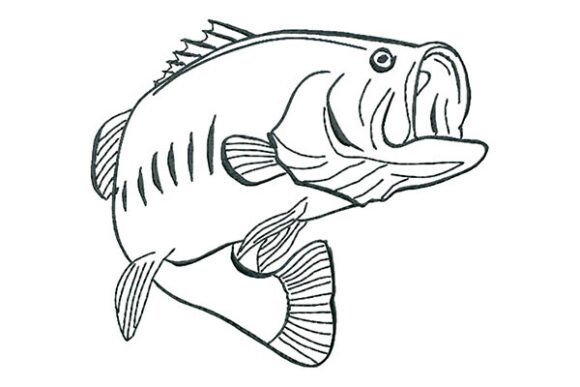
Bass Fish Calligraphy Style Embroidery
A Designer’s First Look: Elegance Meets Angling
As an embroidery designer who’s stitched everything from delicate monograms to dense wildlife motifs, I opened the Bass Fish Calligraphy Style Embroidery file with quiet curiosity—not hype. What stood out immediately was its visual rhythm: a single, fluid bass silhouette rendered in calligraphic strokes, not rigid outlines or cartoonish fills. It doesn’t shout “fish.” It *glides*. The line weight varies naturally—thicker at the tail curve, tapering into fine, expressive fin tips—giving it movement and breath. This isn’t just a fish shape; it’s a hand-drawn gesture translated into stitch logic. For handmade product development, that nuance matters. It signals craftsmanship before the needle even moves.
Fits That Feel Intentional—Not Forced
The Bass Fish Calligraphy Style Embroidery thrives where subtlety elevates utility. I tested it across several real-use scenarios: a natural linen apron for a local fishing guide’s shop, a soft cotton baby blanket for a nursery-themed Etsy listing, and a midweight cotton twill tote bag for a boutique gift set. In each case, the design landed cleanly—not as a sticker, but as part of the item’s voice. On the apron, it sat just above the pocket in a 3.5" hoop size, balancing proportion without overwhelming the fabric’s texture. On the baby blanket, scaled down to 2.75", the flowing lines retained legibility (no broken segments or jagged corners), and the stitch density felt light enough for gentle handling. It’s not an applique design—it’s a clean machine embroidery design built around outline and satin-stitch definition, making it ideal for projects where you want elegance, not bulk.
Real-World Stitching: What Holds Up (and What Needs Care)
This Bass Fish Calligraphy Style Embroidery performs reliably on stable, medium-weight fabrics—think canvas totes, piqué polo shirts, or brushed cotton pillow covers. On stretchy knits like sweatshirt fleece, I recommend a light cutaway stabilizer beneath and a tear-away on top to prevent puckering along those long, curved strokes. On dark fabric, contrast is key: a creamy ecru or heather gray thread reads beautifully against navy or charcoal, while black thread can disappear on deep indigo unless you add a subtle underlay (check your machine’s settings). Curved surfaces—like structured caps—require careful hooping and possibly slight digitizing tweaks (a minor arc adjustment in your editing software helps), but the original file’s smooth vector flow makes that edit intuitive.
Where caution applies: avoid cramming it into sub-2" hoops. Tiny lettering isn’t involved here—but the tail’s fine points and gill-line details need breathing room. Below 2.25", some subtlety blurs. Also, while the stitch density is moderate (not overly dense), tightly woven fabrics like oilcloth or stiff denim may require testing for thread tension balance. Always run a test on scrap first—especially if layering over seams or near garment edges.
Commercial Use Considerations for Sellers
If you’re listing embroidered patches, custom apparel, or nursery decor on Etsy or at craft fairs, this Bass Fish Calligraphy Style Embroidery adds quiet authority. It reads as intentional—not generic clip art. Customers notice that. On product photography, its clean lines translate sharply in flat-lay shots and scale well in zoomed detail views, supporting trust in your handmade presentation. For brand consistency, it pairs effortlessly with minimalist typography or nature-inspired palettes (sage, slate, oat, clay), making it easy to extend across a collection—say, matching kitchen towels, aprons, and baby onesies under one cohesive theme. As a personalized gift option, it avoids cliché while still resonating with anglers, biologists, coastal dwellers, or anyone drawn to organic form.
Design Assets That Support Your Process
The Bass Fish Calligraphy Style Embroidery comes as a ready-to-stitch digital embroidery file—no tracing, no redrawing needed. That saves time when fulfilling rush orders or building seasonal collections (think spring fishing launches or Father’s Day bundles). It also integrates smoothly into printable mockups: the clean silhouette drops cleanly onto lifestyle templates, helping you visualize placement on caps, sleeves, or pillow fronts before cutting fabric. As part of your broader design assets, it’s versatile—not just a standalone motif, but a component you can pair with simple running-stitch borders or coordinate with coordinating fish-scale fill patterns (if you build your own extensions).
Before You Stitch: Practical Checks Every Designer Should Make
- Verify hoop size compatibility—confirm the largest dimension fits your standard hoop before prepping production.
- Review thread color contrast on both light and dark fabric swatches—what reads clearly on white may vanish on charcoal.
- Inspect small details after stitching: check fin tips and eye contour for skipped stitches or thread breaks, especially on textured or napped fabrics.
- Use appropriate stabilizer: medium-weight cutaway for knits, lightweight tear-away for wovens, and fusible for lightweight linens.
- Confirm licensing terms on the Creative Fabrica product page before selling finished items—some embroidery files permit commercial use only with attribution or limit units per license.
Final Thought: When Simplicity Carries Weight
The Bass Fish Calligraphy Style Embroidery won’t dazzle with flash or novelty—but that’s its strength. In a market saturated with busy, over-digitized motifs, it offers clarity, calm, and quiet confidence. It works because it respects the fabric, the stitch, and the person wearing or using the finished product. Whether you’re embroidering a chef’s apron, a baby’s milestone blanket, or a limited-run patch for a conservation nonprofit, this machine embroidery design delivers polish without pretense. It’s not just another fish—it’s a thoughtful detail, executed well. And in handmade work, that’s where value begins.